-
Shop
- Advanced Technologies
- AI Skills
- AI Skills for Creators & Freelancers
- AI Client Management
- AI Ethics
- AI Mindset
- AI Tools & Prompts
- AI Writing & Content Creation
- Audio, Voice & Music
- Design & Visual Creation
- Email, Messaging & Communication
- Freelancing & Business
- Marketing, Ads & Conversion
- Productivity, Workflow & Automation
- SEO & Search Optimization
- Social Media Content & Growth
- Strategy, Planning & Analytics
- Video Creation & Editing
- Apple Accessories
- Bathroom
- Beauty
- Best-Sellers
- Car Accessories
- Car Buying & Ownership
- Confidence
- Dating & Social Skills
- Digital Resources
- Education & Learning
- Family & Parenting
- Fashion
- Alexander McQueen
- Bags
- Balenciaga
- Blazers
- Bottega Veneta
- Brunello Cucinelli
- Burberry
- Chanel
- Chloé
- Dior
- Dolce & Gabbana
- Dresses
- Etro
- Fendi
- Gucci
- Jacquemus
- Jil Sander
- Kiton
- Luggage
- Miu Miu
- Off-White
- Outerwear
- Prada
- Rick Owens
- Saint Laurent
- Shoes
- The Row
- Tom Ford
- Valentino
- Valentino Garavani
- Versace
- Vivienne Westwood
- Fashion Accessories
- Furniture
- Gadgets
- Health & Beauty
- Health & Wellness
- Home Decor
- Home Electronics
- Home Styling & Organization
- Home Supplies
- Kids & Babies
- Kitchen
- Legend Footwear Brands Collection
- Lighting
- Luxury Brands Collection
- Online Business for Beginners
- Parenting & Child Development
- Patio, Lawn & Garden
- Personal Growth
- Personal Style & Fashion
- Pet Care
- Pet Lifestyle & Wellness
- Pet Supplies
- Pets
- Smart Amazon Shopping
- Smart Home Living Guides
- Super Deals
- Travel
- Travel & Adventure
- Wealth
- Wellness
- Popular
- Best deals
Vans Peer Influence: How to Spot Sneaker Trends

A sneaker trend can start as a practical choice, a personal favorite, or a look shared among friends. As you see a style more often—in your neighborhood, at an event, or on your social feed—it may begin to feel familiar and appealing. That familiarity can be useful to notice, but it doesn’t mean you have to follow the crowd.
Our Vans peer influence checklist offers one option for exploring the connection between social influence and sneaker trends. Pair it with your own observations to make style decisions that feel intentional, rather than rushed by hype.
Why Peer Influence Matters in Sneaker Trends
Friends and family can introduce you to shoes you might not have noticed on your own. A recommendation from someone whose style you admire may prompt you to look closer at a silhouette, while seeing a pair repeatedly can make it feel easier to imagine wearing. Local skate scenes, music communities, creators, and online groups can all contribute to that familiarity.
Vans offers a useful example because its shoes appear in different settings and communities. The brand describes its roots and history on its Our Story page. That history doesn’t mean every Vans trend begins in the same community, though. A styling idea you notice at a local event may develop differently from one circulating online.
There’s also a difference between genuine interest and group pressure. You might enjoy a shoe because its shape works with your wardrobe, or you might feel drawn to it mainly because everyone around you seems to have it. Neither reaction is unusual. The useful question is whether the style still appeals to you when you set aside who else is wearing it.
A Practical Checklist for Spotting a Trend
Start by looking beyond a single post or one group of friends. Notice what people wear at school, work, local events, and in the social feeds you already follow. Repetition across different settings can give you a stronger reason to investigate a style than a single popular image.
Pay attention to details, not just brand names. Are you seeing similar low-profile silhouettes, bold colors, or neutral canvas shoes? Are people pairing them with loose pants, shorts, or workwear? The occasion matters too: a shoe worn for a casual weekend may play a different role from one chosen for an event.
Use the table below as a simple observation guide. It is our article guidance, not a description of the exact contents of the product.
| What to notice | Question to ask | Useful next step |
|---|---|---|
| Repeated styles | Is the same look appearing in different places? | Record where and when it appears. |
| Peer influence | Who is wearing or recommending it? | Compare influences across several groups. |
| Staying power | Does interest continue beyond one post or event? | Check back over several weeks. |
| Personal appeal | Would I like this style without the hype? | Compare it with what I already wear. |
Give your observations time to develop. A style that appears repeatedly over several weeks, across more than one community, may have more staying power than a look tied to a single viral moment. Even then, what you’re seeing is a pattern in the places you’ve checked—not proof that everyone is wearing it.
Turn Observations Into Better Style Decisions
Keep your notes brief and specific. You might record the date, setting, shoe details, and outfit combinations you notice. Separate those observations from assumptions: “I saw three people wearing checkerboard patterns” is an observation; “they all bought them because of a creator” is a conclusion you may not have enough information to make.
Consider the limits of your view, too. A small social circle can share similar tastes, and a curated feed may repeatedly show you related content. The Pew Research Center’s social media research offers broader context for how people use these platforms, but your own feed is still only one slice of what people see and wear.
Before buying, take stock of your wardrobe and budget. Think about which clothes you would pair with the shoes, how you prefer your everyday footwear to feel, and whether you would reach for the style after the initial excitement passes. A trend can be worth enjoying without becoming a purchase.
If you also want to organize a broader creative look, our AI-Powered Brand Magic ebook is a separate option for exploring a freelance brand style guide. It’s aimed at creatives and solopreneurs rather than sneaker trend tracking.
Explore the Vans Peer Influence Checklist
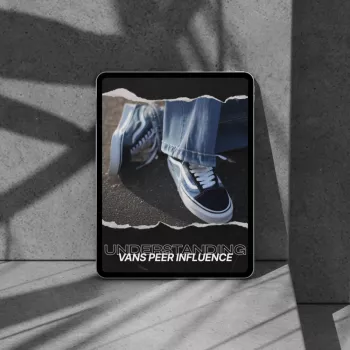
For a closer look at the relationship between peers and sneaker trends, consider our Understanding Vans Peer Influence checklist. Its listed price is $4.99; visit the product page for purchase details.
Our team suggests using it alongside what you notice in your own communities and wardrobe. The goal is to make room for both influences: what’s happening around you and what you actually like wearing.
FAQ
How can peer influence affect sneaker choices?
Recommendations and repeated exposure can make a sneaker style feel more appealing or socially relevant. Your own preferences still matter when deciding what to wear.
How can I tell a sneaker trend from a short-lived post?
Look for recurring styles across different settings and communities, then check whether interest continues over several weeks rather than ending with one post.
How much does the Vans peer influence checklist cost?
The listed price is $4.99. Visit the product page for current purchase details.
Recommended for you
Saint Laurent Smarts: Your Pre-Buy Checklist
Nov 27, 2026
Best Extendable Dining Tables for Small Spaces
Nov 27, 2026













Leave a comment